
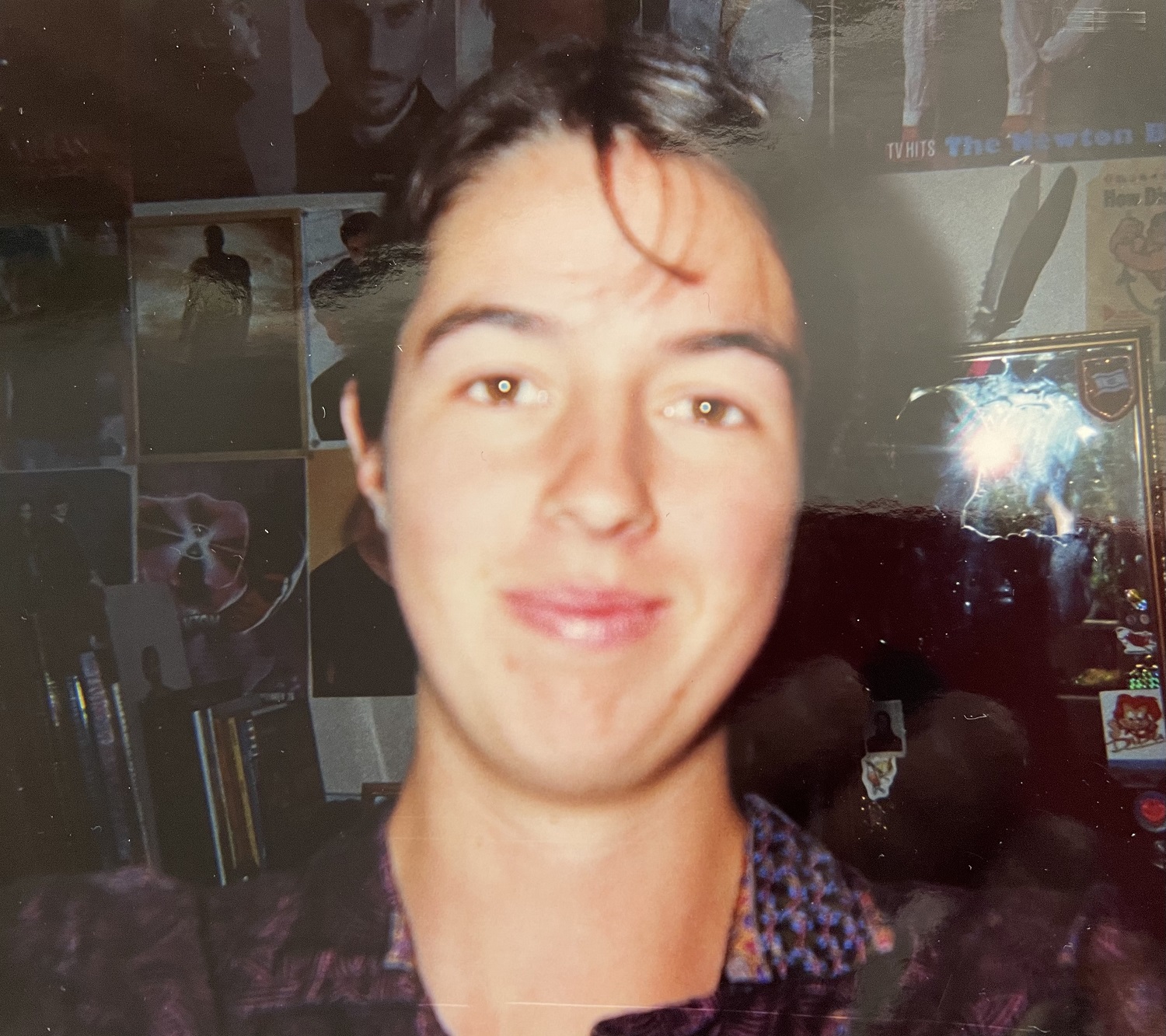
See that picture?
That’s me in 2000. With the long hair up in a ponytail (that hasn’t changed) and the bedroom wall positively covered with posters of movies and movie stars (Joseph Fiennes was the man of the moment I can see) and the grim look that says taking selfies with an actual camera is hard.
This is also the year I had an idea. Or at least, I think I had the idea then. My notes from then are completely lost, which is a shame. I’ve transferred ideas from paper to paper, from note to note. At university I used to spend my study time laying out all my story ideas on the floor, covering my room from end to end, writing them on new paper. Combining some ideas with others. Re-writing the old scraps of ideas onto bigger sheets of paper.
The idea came on top of other ideas, as good ideas often do. The big myth about novellists is that their ideas come fully formed out of their heads and they write them down, just like Mozart in the movie Amadeus. Sometimes, very rarely, this happens. When it does we like to brag about it because it’s just so amazing when it happens. The rest of the time we have one idea. Then we have another. Then we combine them. Or layer them. We discard parts of one and keep others.
This one was born out of Robin Hood fan-fiction. Not like actual Robin Hood. But Robin Hood TV series – the one from the late 1990’s starring the guy who played Will Scarlett in Robin Hood Men in Tights (I was really into Robin Hood – can you tell?). It had some good stories, and some good elements. I took those elements, and combined them with my idea, and threw away some pieces. Over the years I kept going. In 2016 I threw out a whole character I loved, just because they no longer fit where the story was going.
Last week, I finished a draft. I browsed through my idea library to see what to write next. I had intended to start the sequel of the one I’d just finished, but this one tugged at me.
Was it because I had collated all my notes into the same place? Was it because I’d been thinking about it already? It had come up a few times in the early morning as I thought about other things.
Mainly that I remembered having the idea. And then I remembered writing something in the pages of my science book in class during 2000. And I had been thinking about why I hadn’t written down the original idea in its entirety when I had it. So I pulled it out and looked at it. It was old. Like, 21 years old. And I still remembered it. It was still fresh. The ideas were still there.
Why had I put it off for so long? Because I couldn’t think of how to start it? Because I couldn’t think of how to end it? But that had never put me off before. I’ve started books without knowing the ending and the ended just wrote itself. Because other books came along? Maybe.
But I think I was falling prey to the old writer’s block. Not the block where you can’t think of anything to write. I’ve never had that problem. But the block where you can’t write because the words aren’t going to be right. The words aren’t going to be perfect. The story isn’t going to sound “the same” as what’s in your head. That’s the block I was struggling with.
And yet I had written something. By hand, years and years ago. A first chapter with everything it needed: a brave, bold heroine, a mystery to be solved, and a keen hook. When had I written it? Why had I abandoned it? Because the second chapter didn’t match the first. Because it wasn’t “right”.
I thought about putting it off again. But then I thought about what I’d learned having kids and trying to write. That putting any words down on a page, even if it was just two sentences in twenty minutes, was better than nothing. That I couldn’t wait for the timing and the hours and the words to be right. I just had to write something.
It was time. Time for the idea I’d had to be written. I didn’t care if the chapters were terrible. They just had to be a first draft. The second draft could fix the problems of the first – my second drafts always did – I just had to get this idea out of my head and onto paper. I can always go back and fix it.